本文是2026年7月24日由英伟达、微软、Meta、IBM等25家美国科技企业联合发布的联名公开信,由黄仁勋(Jensen Huang)在其 X 账号上作为首条推文发布。核心诉求是反对国会一刀切限制开放权重开源AI模型,论证开放权重对美国AI产业竞争力、国家安全、经济发展的多重正向价值。
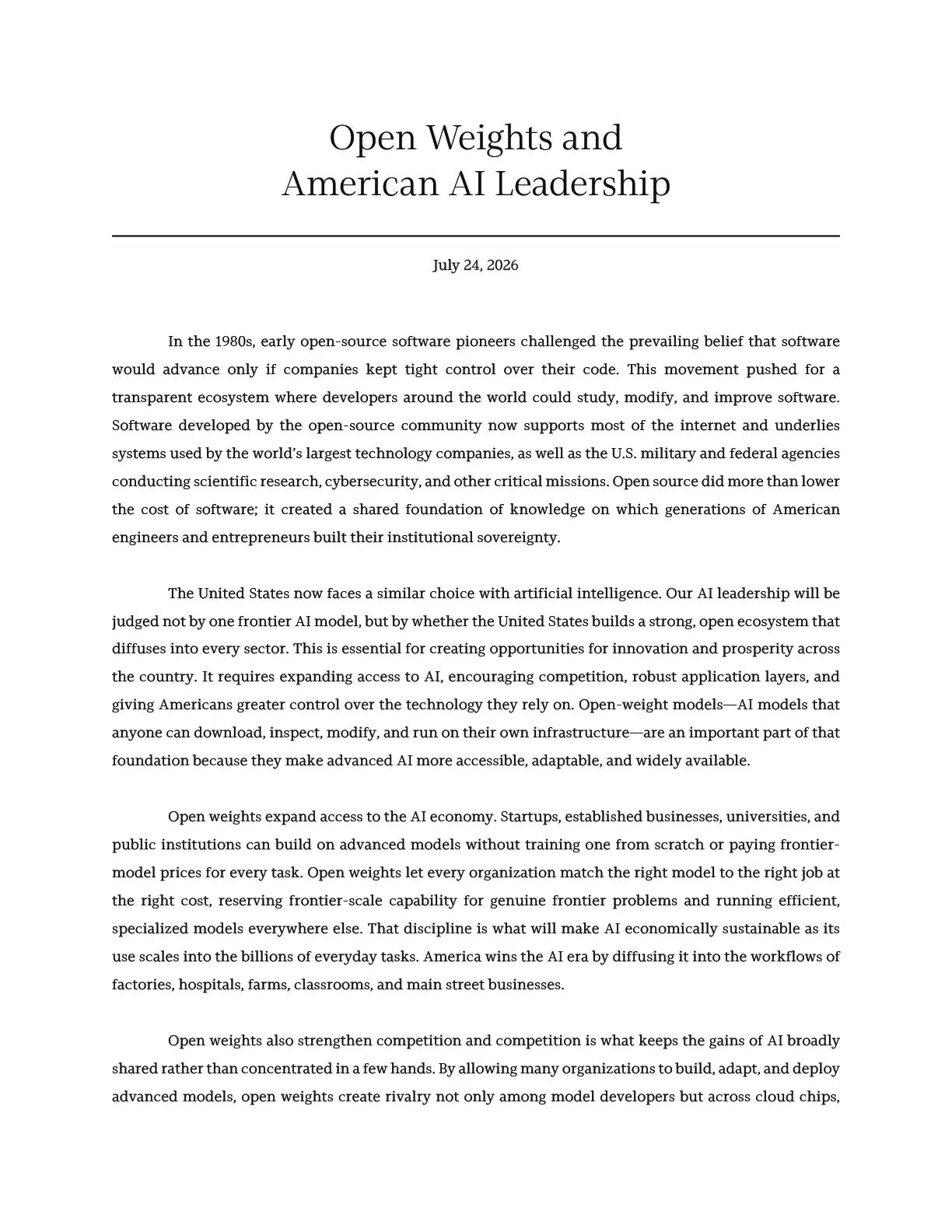
开放权重与美国人工智能领导力
2026年7月24日
三十多年前,软件行业迎来了一个关键转折点,它至今仍在塑造美国的数字优势。彼时,企业与政策制定者需要做出抉择:是固守封闭专有软件,还是拥抱开源模式。开源不只是降低软件成本,更搭建起共享知识底座,一代又一代美国工程师与企业家在此基础上构筑了本国技术主导权。Linux、万维网、云计算等诸多重塑全球经济的创新成果,全都诞生于这套开放协作体系。
如今,美国在人工智能领域正面临相似的抉择。评判我们的AI行业领导力,不能只看某一款前沿大模型,核心要看美国能否搭建一套强劲、开放、渗透各行各业的产业生态。这是在全美范围内创造创新机遇、实现经济繁荣的关键。想要达成这一目标,我们必须拓宽AI技术的可及性、鼓励市场充分竞争、打造完善的应用生态,同时让美国民众对自己日常使用的技术拥有更强掌控权。
开放权重模型——任何人都能下载、核验、修改,并在自有硬件设备上独立运行的AI模型,正是这套生态底座的核心支柱。开放权重大幅降低先进AI的使用门槛,让技术适配性更强、部署方式更多元。企业、初创公司、高校、政府机构无需从零训练大模型,也不用承担前沿闭源模型的巨额使用费,就能按需定制、落地AI能力。
这种模式正在重塑各行各业。制造业企业可以基于开放权重模型,搭建专属产线质检智能系统;医院能够自主微调模型,适配本地患者数据与临床诊疗规范;农场、学校、零售门店都能低成本部署贴合自身需求的AI工具。当AI应用渗透数十亿日常工作场景,开放权重带来的轻量化、低成本部署模式,将成为AI产业可持续发展的核心支撑。美国想要赢得人工智能时代,关键就是把AI能力落地到工厂、医院、农田、课堂与街边商铺的真实业务流程中。
开放权重还能强化市场竞争,而充分竞争是让AI发展红利全民共享、而非集中于少数巨头手中的核心保障。允许多家机构独立开发、适配、部署高端模型,既能在模型研发赛道形成良性竞争,也能催生海量差异化垂直应用。中小企业、初创团队不再被头部闭源模型厂商锁定,不必被迫接受单一供应商的定价、服务条款与功能限制。市场竞争会持续压低AI使用成本,倒逼技术迭代提速,最终让消费者、劳动者、中小企业全部受益。
部分观点声称,限制开放权重、仅依靠闭源模型,才能保障美国AI安全。但事实恰恰相反:单纯依赖少数封闭模型,本身就存在安全隐患。闭源系统同样可能遭遇数据泄露、恶意滥用,或是出现外部无法察觉的算法故障。把全国AI算力与能力集中在少数几套闭源模型上,等于制造了”单点系统性风险”。与之相对,开放模式恰恰是实现AI安全最重要的路径之一。
开放权重意味着全球成千上万独立研究人员、安全工程师、高校学者都能审阅模型底层代码、排查漏洞、识别潜在风险。闭源模型仅有厂商内部团队负责安全检测,而开放体系能调动全球海量第三方力量持续开展安全审计。一旦发现算法偏见、安全漏洞、滥用风险,全球开发者社区可以同步推出修复方案,形成分布式安全防护网络,这是封闭生态无法实现的。
从地缘竞争角度看,开放权重同样是巩固美国全球AI话语权的核心抓手。各国政府、企业选择基于美国开发的开放模型搭建自有系统,本质上是选择一套根植于可靠性、透明度与民主规范的技术生态。白宫新版《人工智能行动规划》也明确提出,开放权重模型能够强化美国AI全球领导力、支撑学术前沿研究、赋能产业与政府数字化转型。
如果美国过早出台严苛禁令、限制本土开放权重模型流通,只会催生两种负面后果:第一,国内创新活力被压制,中小企业与科研机构失去低成本研发工具;第二,海外市场会转向其他国家的开放AI模型,美国将丧失全球AI标准制定权与技术输出优势。相关政策应当区分风险等级,针对超高危前沿模型实施精准管控,而非一刀切限制全部开放权重技术。
开放与安全并非对立,二者可以并行兼顾。行业从业者支持针对性管控高危AI能力,同时呼吁政策制定者保留开放权重的发展空间。唯有依托开放、多元、充分竞争的AI生态,美国才能长期维持人工智能领域的全球领先地位,持续释放技术创新红利,保障本国经济、安全与科技长远利益。
关键术语释义
- Open Weights(开放权重模型):大模型底层参数文件完全公开,使用者可本地下载、二次微调、私有化部署,区别于仅提供API调用、底层代码完全保密的闭源模型(如早期GPT系列)。
- Single points of failure(单点故障风险):若全社会仅依赖少数几家企业的闭源AI,一旦该厂商系统瘫痪、技术断供或算法出现缺陷,全行业都会受到冲击。
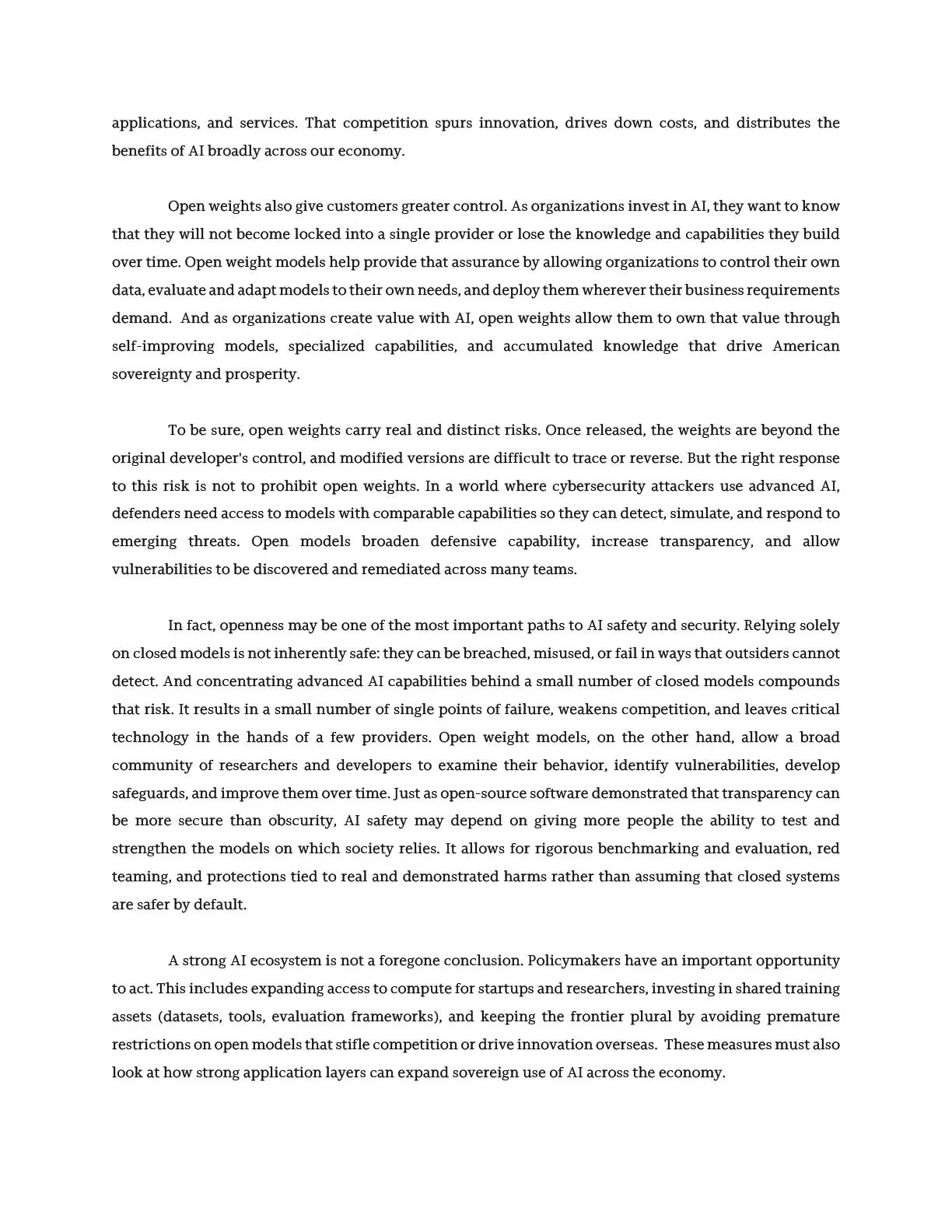
Open Weights and American AI Leadership
July 24, 2026
In the 1980s, early open-source software pioneers challenged the prevailing belief that software would advance only if companies kept tight control over their code. This movement pushed for a transparent ecosystem where developers around the world could study, modify, and improve software. Software developed by the open-source community now supports most of the internet and underlies systems used by the world’s largest technology companies, as well as the U.S. military and federal agencies conducting scientific research, cybersecurity, and other critical missions. Open source did more than lower the cost of software; it created a shared foundation of knowledge on which generations of American engineers and entrepreneurs built their institutional sovereignty.
The United States now faces a similar choice with artificial intelligence. Our AI leadership will be judged not by one frontier AI model, but by whether the United States builds a strong, open ecosystem that diffuses into every sector. This is essential for creating opportunities for innovation and prosperity across the country. It requires expanding access to AI, encouraging competition, robust application layers, and giving Americans greater control over the technology they rely on. Open-weight models—AI models that anyone can download, inspect, modify, and run on their own infrastructure—are an important part of that foundation because they make advanced AI more accessible, adaptable, and widely available.
Open weights expand access to the AI economy. Startups, established businesses, universities, and public institutions can build on advanced models without training one from scratch or paying frontier-model prices for every task. Open weights let every organization match the right model to the right job at the right cost, reserving frontier-scale capability for genuine frontier problems and running efficient, specialized models everywhere else. That discipline is what will make AI economically sustainable as its use scales into the billions of everyday tasks. America wins the AI era by diffusing it into the workflows of factories, hospitals, farms, classrooms, and main street businesses.
Open weights also strengthen competition and competition is what keeps the gains of AI broadly shared rather than concentrated in a few hands. By allowing many organizations to build, adapt, and deploy advanced models, open weights create rivalry not only among model developers but across cloud chips, applications, and services. That competition spurs innovation, drives down costs, and distributes the benefits of AI broadly across our economy.
Open weights also give customers greater control. As organizations invest in AI, they want to know that they will not become locked into a single provider or lose the knowledge and capabilities they build over time. Open weight models help provide that assurance by allowing organizations to control their own data, evaluate and adapt models to their own needs, and deploy them wherever their business requirements demand. And as organizations create value with AI, open weights allow them to own that value through self-improving models, specialized capabilities, and accumulated knowledge that drive American sovereignty and prosperity.
To be sure, open weights carry real and distinct risks. Once released, the weights are beyond the original developer’s control, and modified versions are difficult to trace or reverse. But the right response to this risk is not to prohibit open weights. In a world where cybersecurity attackers use advanced AI, defenders need access to models with comparable capabilities so they can detect, simulate, and respond to emerging threats. Open models broaden defensive capability, increase transparency, and allow vulnerabilities to be discovered and remediated across many teams.
In fact, openness may be one of the most important paths to AI safety and security. Relying solely on closed models is not inherently safe: they can be breached, misused, or fail in ways that outsiders cannot detect. And concentrating advanced AI capabilities behind a small number of closed models compounds that risk. It results in a small number of single points of failure, weakens competition, and leaves critical technology in the hands of a few providers. Open weight models, on the other hand, allow a broad community of researchers and developers to examine their behavior, identify vulnerabilities, develop safeguards, and improve them over time. Just as open-source software demonstrated that transparency can be more secure than obscurity, AI safety may depend on giving more people the ability to test and strengthen the models on which society relies. It allows for rigorous benchmarking and evaluation, red teaming, and protections tied to real and demonstrated harms rather than assuming that closed systems are safer by default.
A strong AI ecosystem is not a foregone conclusion. Policymakers have an important opportunity to act. This includes expanding access to compute for startups and researchers, investing in shared training assets (datasets, tools, evaluation frameworks), and keeping the frontier plural by avoiding premature restrictions on open models that stifle competition or drive innovation overseas. These measures must also look at how strong application layers can expand sovereign use of AI across the economy.
In shaping this ecosystem, policymakers should be careful not to conflate legitimate model-development techniques with misappropriation. Distillation, or the practice of using one model’s outputs to help train or improve another, is a widely used technique for model improvement, evaluation, and validation. It reflects a long tradition of learning from, building upon, and improving existing technologies, a tradition that has helped drive innovation since the rise of the open-source software movement. By contrast, unlawful efforts to extract value from closed models raise legitimate concerns. Those concerns should be addressed through targeted legal and commercial frameworks rather than sweeping restrictions on techniques that play an important role in AI innovation.
The age of AI can be one of prosperity. With the right choices, open weight AI can expand opportunity, strengthen competition, extend American technological leadership, mitigate risk, and ensure that the benefits of this extraordinary technology are shared broadly across our economy. That future is worth building, and the United States should lead in building it.
联署 / Co-Signed by:
American Innovators Network · Andreessen Horowitz · Arcee AI · Arena · Black Forest Labs · Box · CrowdStrike · Dell Technologies · Emergence Capital · Hugging Face · IBM · The Linux Foundation · Mariana Minerals · Meta · Microsoft · Mistral · Mozilla · NVIDIA · Palantir · Perplexity · Reflection · Replit · ServiceNow · Telnyx · Y Combinator
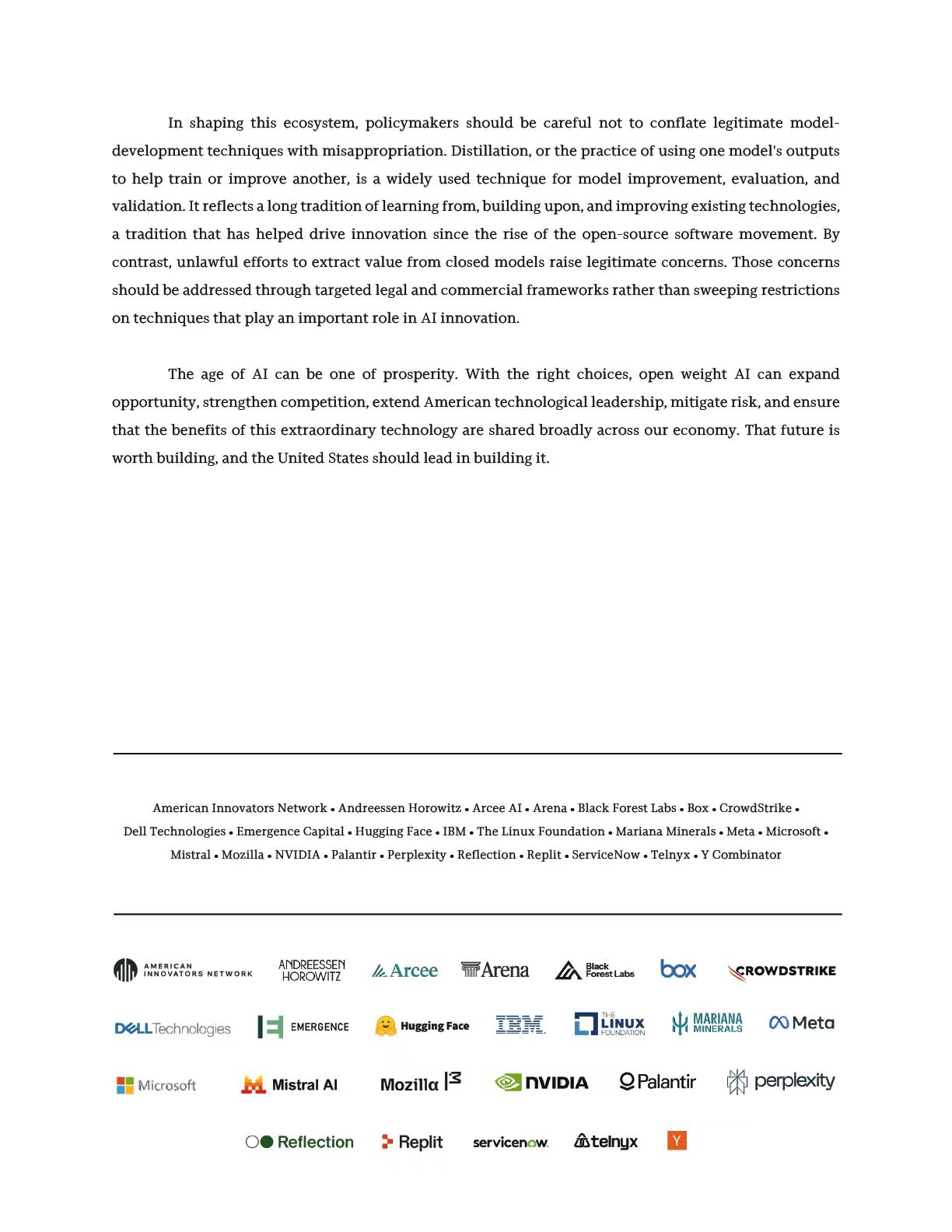
From Jensen Huang’s first X post, July 24, 2026. Co-signed by 25+ organizations.
本文作者:Samjoe Yang
本文链接: https://need.uno/001-huang-ren-xun-shou-tiao-tui-wen-open-weights-and-american-ai-leadership/
版权声明:本作品采用 知识共享署名-相同方式共享 4.0 国际许可协议 进行许可。
评论